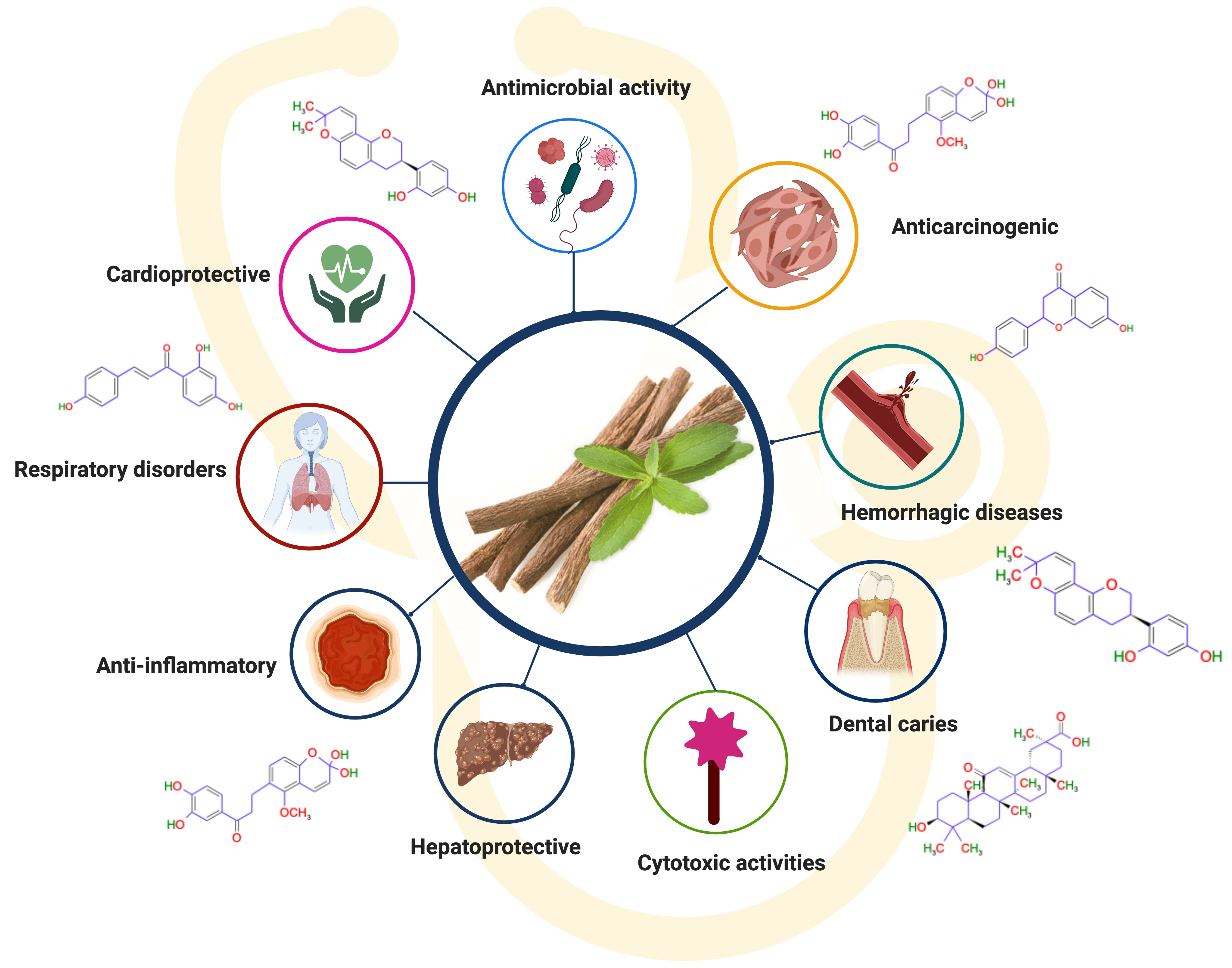
Licorice, called “gancao” (meaning “sweet grass”) in China, was recorded in the Shennong׳s Classic of Materia Medica around 2100 BC and widely used in traditional Chinese medicine (TCM) to this day for its life-enhancing properties, nourishing qi, alleviating pain, tonifying spleen and stomach, eliminating phlegm, and relieving coughing.
More recent tests show licorice contains more than 20 triterpenoids (such as glycyrrhizin) and nearly 300 flavonoids that contribute to its biological activity as antiviral/antimicrobial, anti-inflammatory and antitumor. While glycyrrhizin is a key component, it can also cause side effects like high blood pressure when consumed in large amounts.
The Code of Hammurabi, written about 3,800 years ago by the 6th King of Babylon and later about 3,000 years ago by the ancient Egyptians, who created a tonic with it and packed it in funeral jars to carry into the afterlife. Famous generals from Alexander the Great and Julius Caesar to Napoleon Bonaparte carried licorice with them.
Trademark science today is sponsored by for-profit businesses! True science is complex. Help me simplify/share it widely. “No one can serve two masters.. You cannot serve both God and your riches.” - Matthew 6:24.
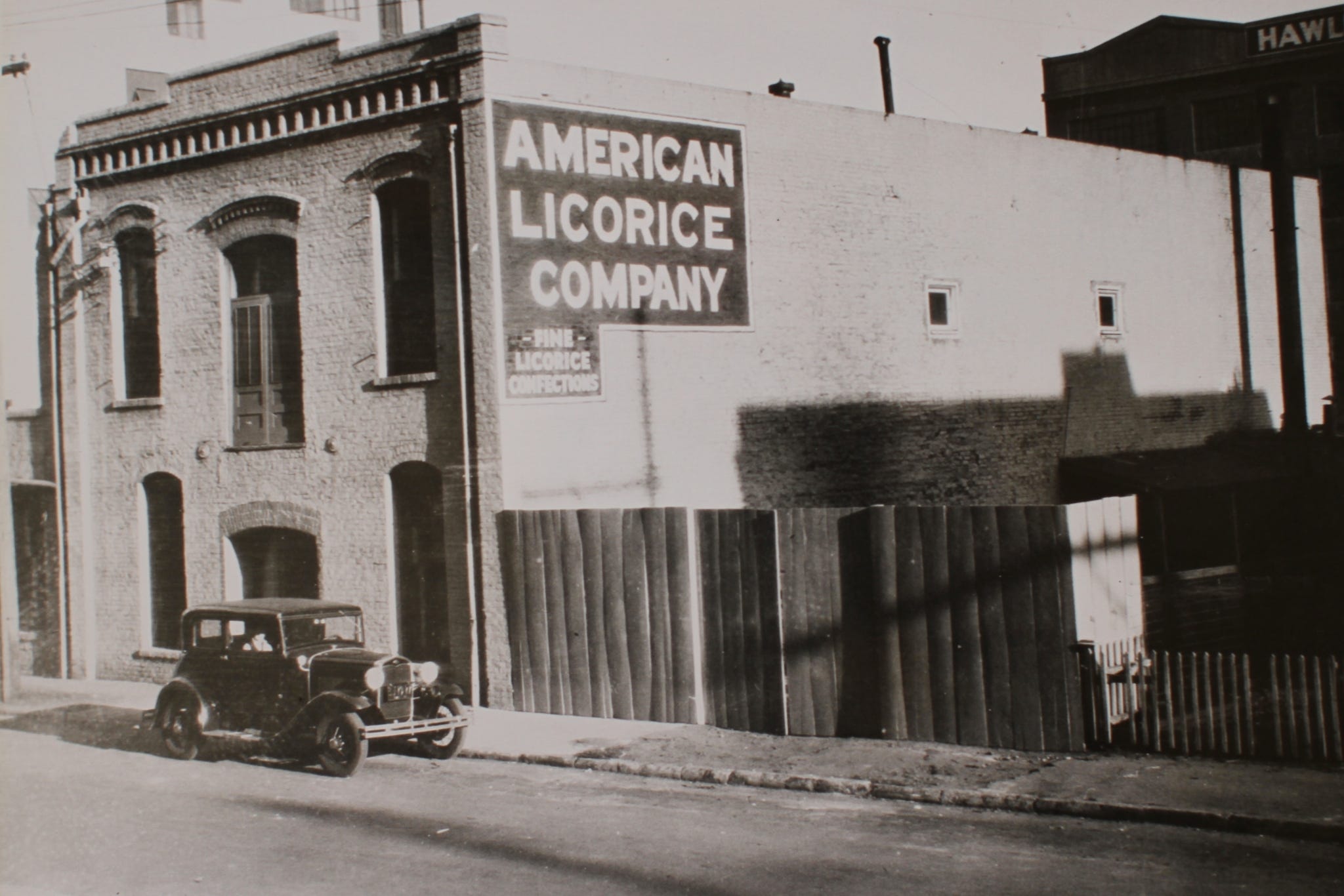
In the Western world, licorice root was used in tobacco products (19th century), and as a flavoring in candies and confectionery (19th century England and then by The American Licorice Company in 1914). In the 20th century, however, lower sugar prices and cheap mass-produced artificial synthetic flavors from the chemical/petroleum industry allowed the candy and tobacco industries to not only scale up production and scale down prices by eliminating licorice, but also make the products more addictive (sugar and synthetic flavors, no natural fibers, etc.).
Today, Red Vines Original Red Licorice Twists by The American Licorice Company contain corn syrup, wheat flour, high fructose corn syrup, citric acid, artificial flavor, and Red 40! The black Licorice version still has a small amount of licorice extract!
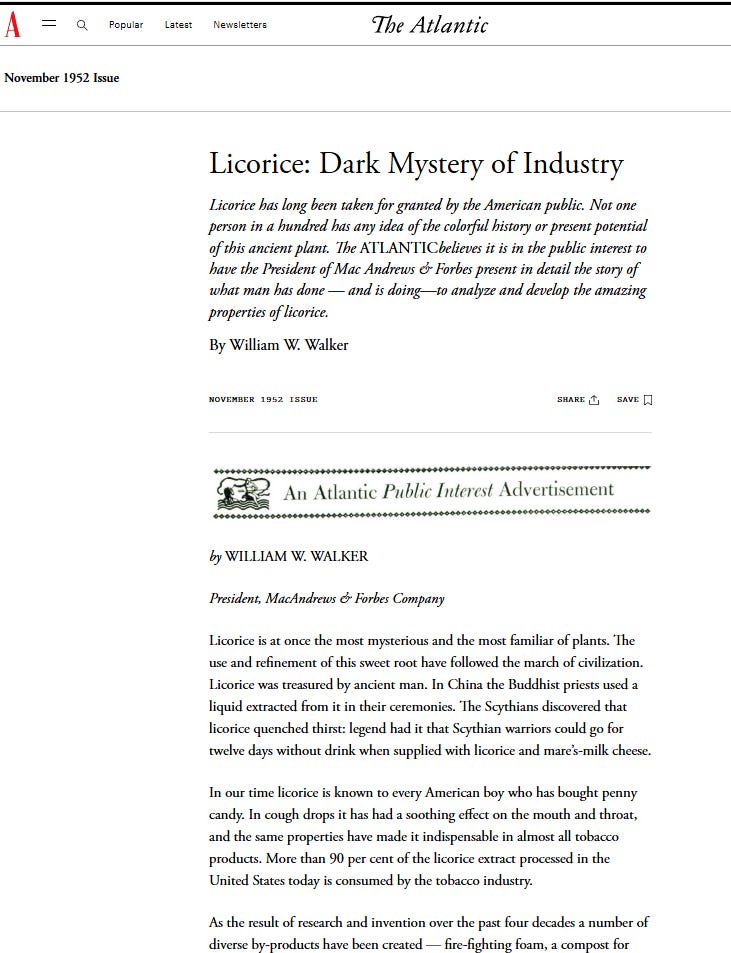
The declining use of licorice in America caused such a frustration among some American intellectuals that The Atlantic published a Public Interest Advertisement Article (similar to infomercial today) by a lamenting licorice and chocolate distributor in 1952. I am including some snippets below:
“Licorice is at once the most mysterious and the most familiar of plants. The use and refinement of this sweet root have followed the march of civilization. Licorice was treasured by ancient man. In China the Buddhist priests used a liquid extracted from it in their ceremonies. The Scythians discovered that licorice quenched thirst: legend had it that Scythian warriors could go for twelve days without drink when supplied with licorice and mare’s-milk cheese.
In our time licorice is known to every American boy who has bought penny candy. In cough drops it has had a soothing effect on the mouth and throat, and the same properties have made it indispensable in almost all tobacco products. More than 90 per cent of the licorice extract processed in the United States today is consumed by the tobacco industry.
..
Licorice has been grown in many parts of the world, as far north as England and the United States, but the primary supply still comes from the old countries around the Mediterranean — Spain, Italy, Greece, Turkey, and Syria — and from Iraq and parts of Russia and of China. Of these, the most important source of supply by far is Turkey and its Levantine neighbors.
The licorice plant is a leguminous shrub reaching a height of several feet. It sends down a taproot which develops a thicket of runners sometimes 25 feet long. When the tangled root is pulled out of the ground at harvest time every three or four years — some tendrils remain to carry on the propagation to a new crop. Only the root of the plant has commercial value. The botanical name for licorice is Glycyrrhiza — a word derived from the Greek, meaning “sweet root.” The characteristic principle of the root is known in chemistry as glycyrrhizin, a substance nearly fifty times as sweet as cane sugar. …
Licorice was an iron ration for the Scythians and for the armies of Alexander the Great, and the conquering Caesars regularly carried licorice root as an indispensable supply on their marches into Africa, Gaul, and Spain.
The Greek physicians of Aristotle’s day prescribed licorice for patients suffering from asthma, dry cough, and maladies of the chest. Mixed with honey it was also administered for wounds.
..
In the penny candy stores early in this century American boys were buying licorice whips, licorice shoestrings, licorice jujubes — and the kids loved them because they were chewy and lasted so long. What few people realize is that much of the candy which passes as licorice among the young citizenry contains little if any licorice. It draws its characteristic flavor from oil of anise which has long been confused with licorice because it is frequently used to give licorice confections a more aromatic character.. Licorice is used in tobacco products because of three properties which are not to be found in combination to the same degree in any other compound. It serves as a flavoring and sweetening agent. As a blending ingredient, it improves the quality of mildness. And it helps the tobacco to retain the proper amount of moisture and flexibility between the time of manufacture and its use by the consumer.
..
What is in store for licorice, the solace of the mighty and the meek down the corridors of time, the familiar and the unknown, the untested gift of nature whose potential after thousands of years has only been glimpsed in the last forty?
Time alone will tell. But if the promise of an almost incredible past, the assurances of the last few years, and the determination of the licorice industry are any indication, a dormant giant may well spring into amazing activity in the service of mankind.!”
This article is my gift to seekers like you. It takes a lot of time to research and write these articles. I did my part. You can do yours by sharing the articles to expand our network of critical thinkers.