
How to Research Harmful Side Effects of Each Drug
A Primer on NNT and other Important Facts about Medicines

In my recent review of Confessions of a Medical Heretic, I discussed how some prominent physicians like Dr. Robert Mendelsohn and Dr. Peter Gøtzsche have criticized the medical establishment’s for-profit approach to over-diagnosing and overmedicating patients, by downplaying the harmful effects of various medicines.
Most people do not know how to truly research the harmful side effects of drugs. This article will show us how one can find out the “full extent” of harms potentially associated with any medicine. No part of this educational article is intended as medical or pharmaceutical advice to treat or prevent any disease.
Physicians’ Desk Reference
First, identify the medicine’s full scientific name and search in databases like the Physicians’ Desk Reference. For example, if you search for Metformin, you need to then identify the exact brand you are prescribed:
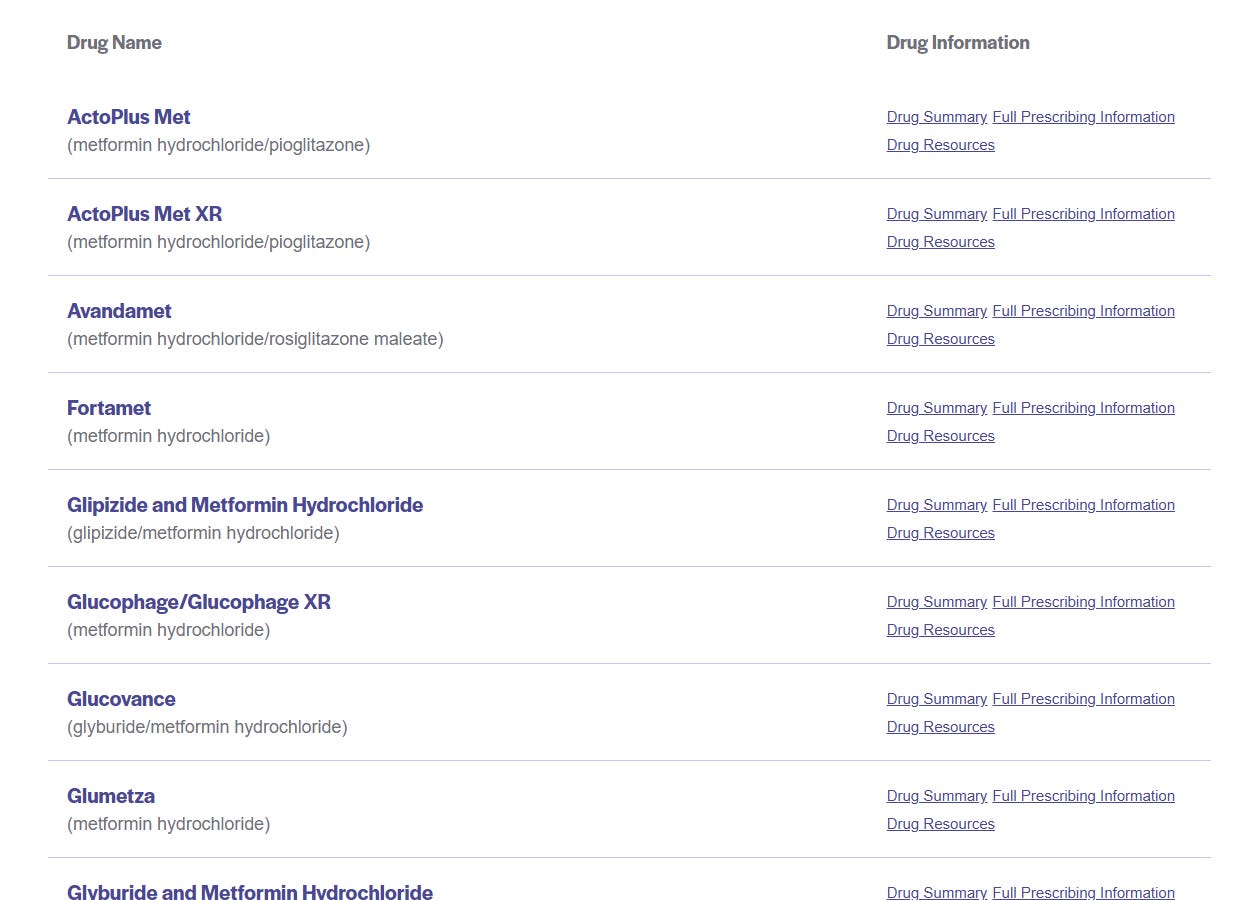
Let’s say it is Glumetza (metformin hydrochloride). If you click on that drug, it will bring up “https://www.pdr.net/drug-summary/?drugLabelId=843” Then you can click on DRUG SUMMARY and look for Adverse reactions:
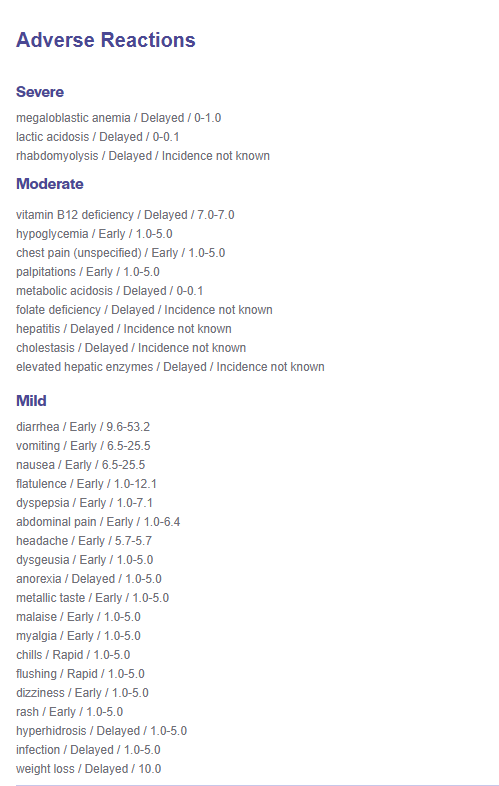
For each potential harm, you see a numerical ranges that indicates the percentage frequency, or incidence rate, of patients who reported that reaction in clinical trials. For example, 1-5% of patients in the clinical trials reported heart palpitations. Critics like Dr. Goetzche provide epidemiological evidence (in his book Deadly Medicines and Organised Crime: How Big Pharma Has Corrupted Healthcare) to show these “risk” numbers are grossly underestimated because meticulously designed clinical trials select treatment and placebo groups with the intent of maximizing the reported benefit/risk ratio of the drug.
Whether the numbers are realistic or grossly underestimated, I would be personally concerned about even a 0.1% risk of severe conditions like lactic acidosis, which is serious (and actually discussed in my article The Serious Risks Associated with Metformin and Ozempic) or any delayed risk of higher than 0.1% or early effect of higher than 1%. Many of the drugs’ harmful effects show up over time and are less likely to be reported or tracked than early effects.
Boxed Warnings
I would also check the link that says “Boxed Warning:”
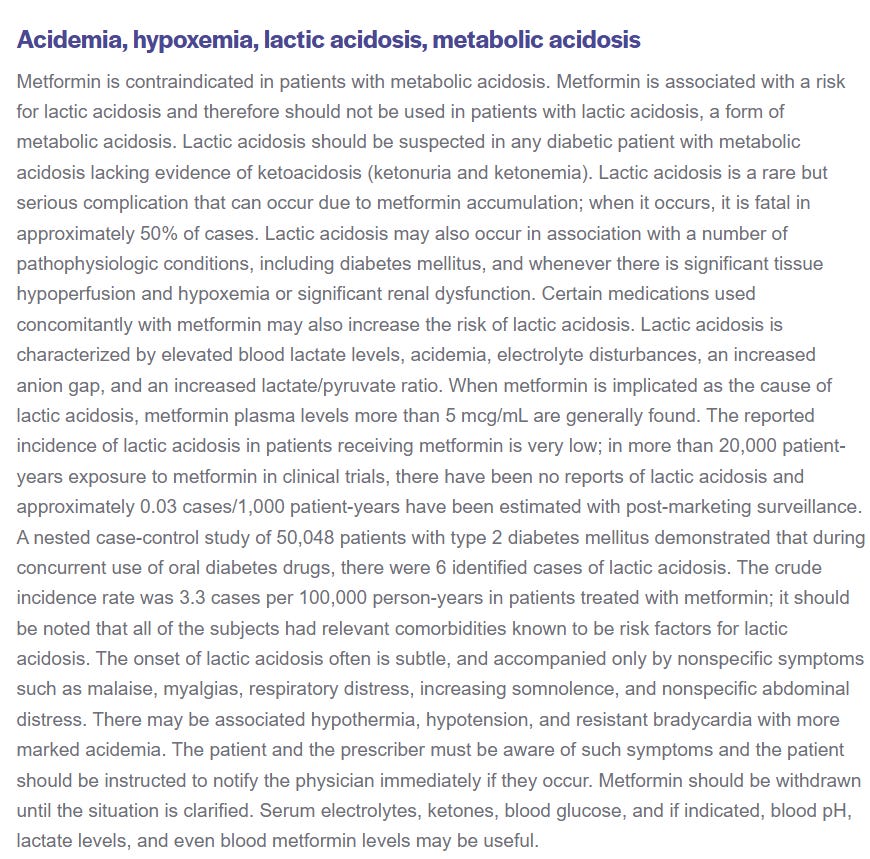
I know these are technical nuances. I wouldn’t read them for risk assessment but to find out about early warning signs. In this case, I would pay attention to:
“The onset of lactic acidosis often is subtle, and accompanied only by nonspecific symptoms such as malaise, myalgias, respiratory distress, increasing somnolence, and nonspecific abdominal distress. There may be associated hypothermia, hypotension, and resistant bradycardia with more marked acidemia. The patient and the prescriber must be aware of such symptoms.”
Other Brands in the Same Family of Drugs
But remember, these particular risks were revealed in the clinical trials for only one brand of Metformin. Every clinical trial focuses on certain end points and side effects. To really understand all potential harms associated with this family of medication (Metformin), I would check other brands like Janumet, for which I see several other serious harms besides those already specified and measured for the other brand:
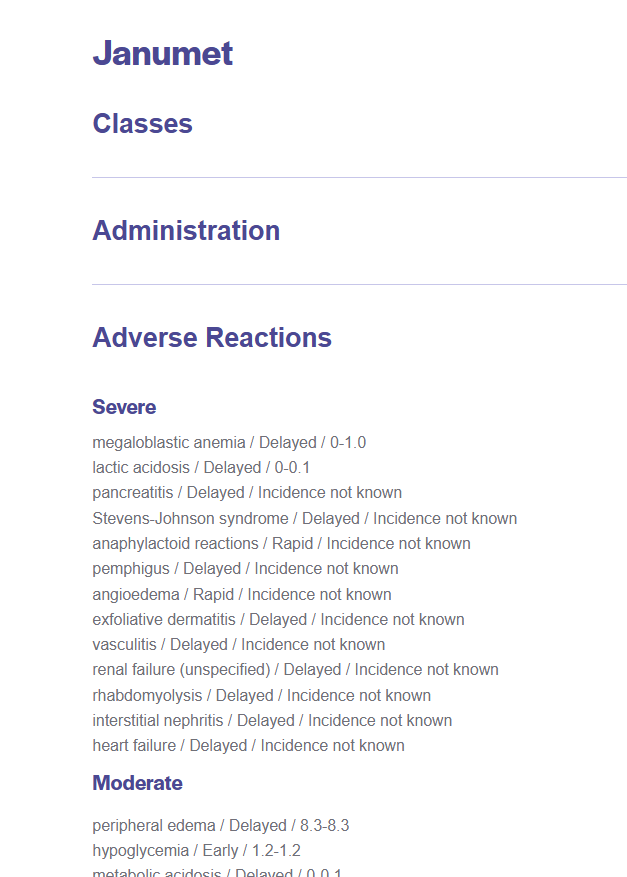
These are harms that have been reported or observed by experts or patients during post-marketing surveillance when total patient exposure numbers are unclear so the frequency cannot be estimated from available clinical data. Some of these are very serious such as pancreatitis, angioedema, vasculitis, renal (kidney) and heart failure!
AI Research of Metabolic Disruptions Caused by the Drug
Another method to check for the harmful effects of any group of drugs is to use Artificial Intelligence and smart searches using this type of queue: “Please list all metabolic pathways in the body disrupted by metformin, and all possible diseases and pathologies resulting from each of these disruptions.” And I asked AI to show all of that in a diagram and image. Here is what I got:
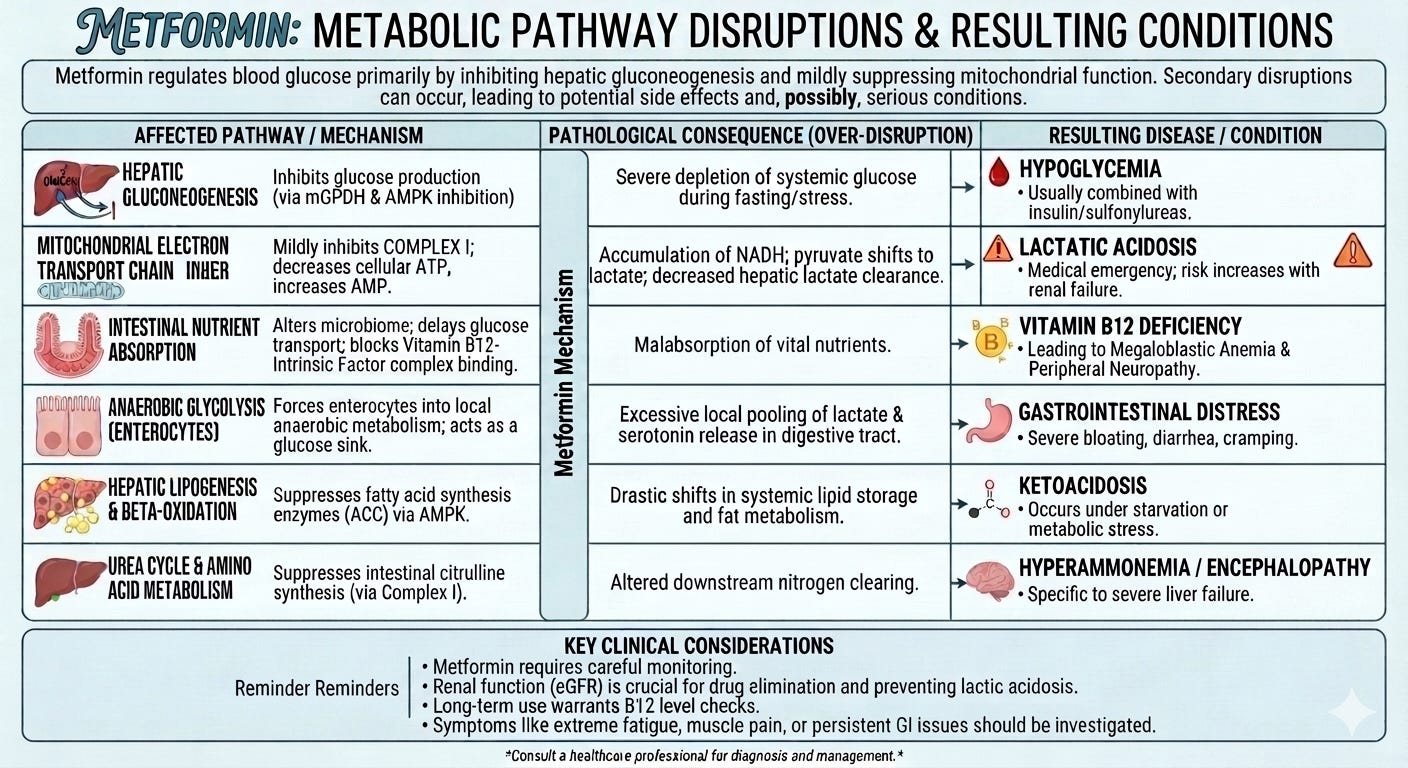
It’s crucial for a drug user to understand all the metabolic disruptions. If you have time and interest, you should read my articles that simplify the human metabolism and then even further educating yourself by searching in “Scholarly articles” for metabolic pathways and pathologies associated with each disease and drug used to treat it.
Is The Drug Worth the Risks?
It is wise to research “The Number Needed to Treat” (NNT) of a drug, which is a medical and statistical measure that shows how many patients on average (statistically, based on clinical trial data) must receive a specific treatment for one person to experience a positive benefit or avoid a bad outcome. For an ideal drug NNT is 1, meaning everyone is helped by the treatment. For such a drug, a patient may consider taking some of the risks associated with the drug.
But most drugs have NNT’s much higher than one, even by manufacturer’s own assessment. For metformin, for example, in the landmark Diabetes Prevention Program, the 3-year NNT for generic metformin (850 mg twice daily) was about 14 to prevent one person from progressing from prediabetes to type 2 diabetes. In comparison, lifestyle changes had an NNT of about 7 in the same study, meaning diet and exercise prevented diabetes in twice as many people relative to the drug. Critics of the drug industry, like Dr. Gøtzsche believe the real NNTs are much higher than those published by the manufacturers, and for many common drugs are 50 or higher. In other words, only one out of 50 people, or about 2%, who take many medicines experience a definite improvement in their condition and avoid a bad outcome that would happen without the drug. At the same time, the various harmful side effects of drugs sometimes impact 50% or more of all the patients over time. For example, for Metformin group of drugs, at least 50% of patients suffer from just gastrointestinal (diarrhea, gas, nausea, etc.) dysfunctions and Vitamin B12 deficiency.
It is wise to check the NNT of the drug you are researching. I personally don’t like numbers higher than 5.
Any Natural Alternatives?
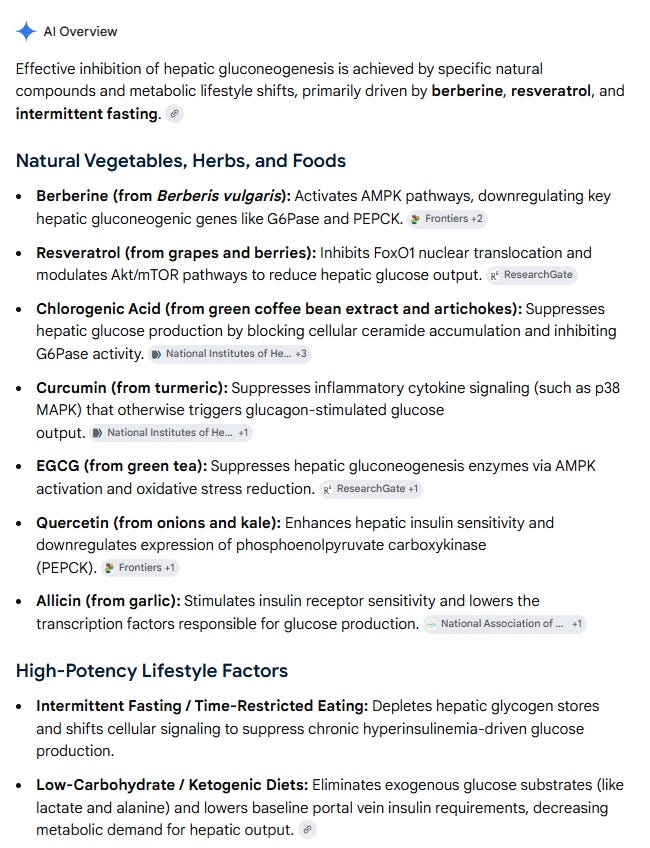
You may ask, what are my alternatives to these drugs if I am concerned about their harmful effects? Your first solution is to read my articles offering natural paths to impact our metabolism. You can also search natural pathways to create a similar effect to the drug, for example in the diagram above, we see Metformin inhibits “Hepatic Gluconeogenesis,” which means it blocks our liver’s synthesis of new glucose during insulin resistance (because the body cannot metabolize the sugar in the blood. So a useful AI search in this case would be “Please list the top 10 most effective natural vegetables, herbs and food items and lifestyle factors with high potency in inhibiting hepatic gluconeogenesis.” This is what I got and some may be worth the try if one is alarmed at the harms associated with the medicine, although I would be cautious because like medicines, some of these natural factors, if done excessively, could have their own side effects:
For example, when I did my own research about Metformin, I found the following:
Natural Alternatives to Metformin?

In a recent article, I discussed how some popular drugs for controlling weight or blood glucose can fool our body into releasing more insulin or curbing our appetite. But are there natural alternativ…
Helpful and inciteful - especially the NNT (number needing to treat) - did not know that :-)
So thankful for this article! Helps reduce confusion :-)